Saturday, February 20, 2010

Indonesia: Ulemas Condemn Miss Transvestite Pageant


Ulemas condemn Miss Transvestite pageant

Hotli Simanjuntak ,  The Jakarta Post ,  Banda Aceh   |  Mon, 02/15/2010 10:01 AM  |  Headlines
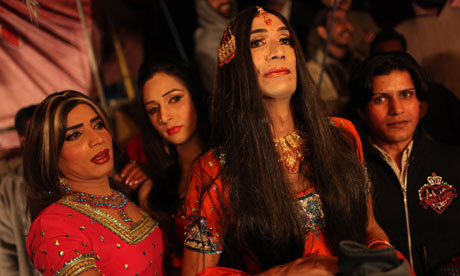
Crossing the line: A Miss Transvestite Aceh contestant takes a photo backstage prior to the announcement of the winner of the Aceh Cultural and Social Envoy 2010, in Banda Aceh on Saturday evening. Transvestites face discrimination in the staunchly Muslim province of Aceh, which also bans homosexuality under its sharia bylaw.  JP/Hotli SimanjuntakCrossing the line: A Miss Transvestite Aceh contestant takes a photo backstage prior to the announcement of the winner of the Aceh Cultural and Social Envoy 2010, in Banda Aceh on Saturday evening. Transvestites face discrimination in the staunchly Muslim province of Aceh, which also bans homosexuality under its sharia bylaw. JP/Hotli Simanjuntak
Participants were met with applause, but also taunts when they stepped on the catwalk during a Miss Transvestite Aceh pageant on Saturday evening.

The pageant, held at the Radio Republik Indonesia building and organized by transgender rights organization Putro Sejati Aceh, was aimed at selecting a representative for the national contest as well as campaigning on transgender issues.

”Transvestites are marginalized. We demand equal rights,” Sherly, who chairs Putro Sejati Aceh, told The Jakarta Post.

She said people in Aceh despised them and discriminated against them for their gender identity.

This was a burden on transvestites who subsequently lost confidence in expressing themselves, especially in education, she added. “Many people are antagonistic and call us ’sissies’. We are afraid to go to school or university to study,” Sherly said.

The implementation of Islam sharia law in Aceh, she said, placed them in a difficult position.

An event to select the Acehnese Social Envoy 2010, the pageant featured 40 participants wearing the traditional costumes of their respective regencies. Zifana Letisia from north Aceh won the contest.

“The winner will be sent to the national event,” Timmy, head of the organizing committee, said.

”We hope the event raises awareness among Acehnese about transvestites,” she said.

Timmy said organizers obtained consent from sharia officials to run the event.

“I believe the event was successful because of public support. The fact that it ran without incident is testament to that support.”

Rini, a member of the judging panel, hailed the event as a positive retort to those angered by transvestites.

”This is an opportunity [for transvestites] to show their creativity and prove they have equal rights,” she said, adding that many Acehnese saw transgenderism as sinful.

“Sin is a personal affair with God. We can’t judge someone a sinner because they are a transvestite,” she said.

However, the road ahead for transvestites is rocky as Ulemas criticized the contest.

“We condemn the pageant. It has tainted sharia in Aceh,” Tengku Faisal Ali, the secretary-general of Aceh Ulema Association (HUDA), was quoted as saying Sunday by Antara news agency.

Criticism also came from provincial leaders, with legislator Darmuda saying, “We can’t tolerate transvestite pageants. This violates the values of the majority of Acehnese who are Muslims.”


Bookmark and Share

Thursday, February 18, 2010

Pakistan's Hijra Transgender Minority Finds Its Voice

From the Guardian UK

Declan Walsh in Islamabad
guardian.co.uk, Friday 29 January 2010

Harassed, intimidated, abused: but now Pakistan's hijra transgender minority finds its voice
New civil rights for Pakistan's long-oppressed 'wedding dancers' offer hope of a better life

Down a grimy alleyway in Rawalpindi, in the heart of Pakistan's military establishment, a striking figure tweaked her makeup and squirted a dash of perfume under her arms.

Life as a hijra, as Pakistan's transgender minority is known, can be tough, said 21-year-old Alisha, recounting tales of extortion, sexual violence and predatory policemen. But of late things have started to improve.

The government has offered help, the hijras' plight has come into the public eye, and even the police are showing a little respect.

"They call us the chief justice's darlings," she said.

An unlikely revolution is stirring among Pakistan's transgender community. Over the past six months the supreme court has issued a series of ground-breaking judgments in favour of hijras, who have long lived under a cloud of disapprobation and discrimination.

Spurred by the forceful chief justice, Iftikhar Chaudhry, who was restored after countrywide protests last year, normally moribund authorities have been ordered to ensure hijras enjoy the same rights as other Pakistanis, in matters of inheritance, employment and election registration.

Police have been warned to cease harassment and intimidation. Pakistan's national database and registration authority, which issues ID cards, has been told to research a third option under the "sex" column.

"Times are changing," said Almas Bobby, leader of one of the largest group of hijras in Rawalpindi. "Our community feels good for the first time in 60 years."

The changes have triggered a heady sense of possibility.

In October hijras in the southern city of Sukkur fielded the country's first hijras cricket team. After winning their inaugural match, the captain thanked the chief justice.

The exuberance is spreading. Earlier this month about 100 hijras from across Punjab crammed into a tented rooftop area for a raucous dance party.

Showers of rose petals filled the air as hijras of all ages, draped in sequined dresses and bedecked in costume jewellery, danced into the small hours – whirling and swinging their hips in the manner of Bollywood movie stars.

The hijras' roots run deep in Asia: many were respected courtesans in the courts of the Moghul emperors who ruled south Asia in the 17th and 18th centuries. One even commanded troops into battle.

But behind the merriment, hijra life can be lonely and dangerous in a conservative society such as Pakistan.

Most hijras describe themselves as "professional wedding dancers" (women performers are forbidden under Pakistani law) but campaigners say their main sources of income hail from begging and prostitution.

Alisha, who worked as a makeup artist to pay for silicon implants, sported a 36B bra under a red sequinned dress. "I've always felt like a girl in my soul," she said. But her voice also rang with sadness: her middle-class Islamabad family cast her out. She pointed to Azeem, a middle-aged hijra who once worked as head of housekeeping in a five-star hotel.

"Now she is my mother and father," Alisha said.

Although often referred to as "eunuchs", many of Pakistan's hijras have not undergone gender reassignment surgery, according to campaigners. The medical and psychological services available in other Asian countries, such as Thailand, are either absent or operate in the shadows. A plastic surgeon in Rawalpindi, speaking on condition of anonymity, said he would only operate on hijras after hours.

"It would not raise the prestige of the clinic if they were seen," he said.

The surgeon said he also treated a minority of women seeking gender ­reassignment surgery.

"They come in with bandages on their breasts, which causes ulcers and lesions, threatening to commit suicide if we don't operate," he said.

Back at the party in Rawalpindi a group of men wearing regular shalwar kameez, loose trousers and tunic, watched from the back of the room. They were the "sponsors" – often married men who keep hijras as mistresses.

The men watched silently, filming with their mobile phones, but sometimes stepped forward to cast bundles of 10 rupee notes over their favourite dancers – and in so doing, sent banknote images of Muhammad Ali Jinnah, Pakistan's founding father, fluttering to the ground.

An unlikely revolutionary

The man leading the hijras' modern crusade is an unlikely warrior: a lawyer who specialises in Islamic law. Islamabad barrister Muhammad Aslam Khaki instigated the supreme court cases last year after reading about a brutal incident in Taxila, near the capital, where police allegedly robbed and raped a group of eight hijra wedding dancers.

"People don't consider them as human beings. They don't like to eat with them, drink with them or shake their hands," he said. "But they are full citizens of Pakistan like everyone else."

It is not the first time the softly-spoken lawyer has challenged Pakistan's status quo. Last year Khaki persuaded a federal Islamic court to overturn the punishment for drinking alcohol – 40 lashes of the whip – on the basis that it was not in accordance with the Qur'an. Later, he won a declaration that prisoners should be allowed conjugal rights with their wives during visiting hours – also, he says, a little-known provision of Islam.

"Ours is the most misunderstood religion," he said.

But his advocacy for hijras is a bridge too far for some. He has received death threats from Shabab e-Milli, an offshoot of the youth wing of Pakistan's main religious party, Jamaat e-Islami. "They say I am protecting the gay culture. But I am protecting them from the police culture of torture and sex abuse."


Bookmark and Share

Audio Slideshow: New Life Beckons for the Hijra, Pakistan's Transgender Community

From the Guardian UK - January 29, 2010

Hijra transgender men in Rawalpindi, Pakistan

Pakistani hijras, or transgender men, at a function on the outskirts of the garrison city Rawalpindi. Pakistan's supreme court has issued a number of groundbreaking orders for the government and police to afford hijras the same civil rights as other citizens. Photograph: Declan Walsh

The transgender hijra community, often known as 'wedding dancers', has suffered decades of discrimination and harassment in Pakistan. But things have started to change, with new rights and laws offering hope to this long-oppressed minority. Declan Walsh reports

Audio Slideshow


Bookmark and Share

Pakistan’s ’Third Gender’ Seek Greater Rights


by Elena Becatoros
Associated Press
Monday Feb 8, 2010


In this Feb. 12, 2009 photo, Almas Bobby poses at her home in Rawalpindi, Pakistan.
In this Feb. 12, 2009 photo, Almas Bobby poses at her home in Rawalpindi, Pakistan.    (Source:AP Photo/B.K.Bangash)

Taunted at home, Sanhya ran away at age 12, searching for acceptance as she sees herself - neither male nor female, but a member of a third gender.

Pakistan’s transgender community has long lived on society’s margins, harassed by police, ridiculed as freaks, pitied as the outcast people of Allah and often rejected by their own families. Now the Supreme Court is giving them hope through a petition for their rights to be respected.

"People are recognizing that we are also human beings," said Almas Bobby, who acts as head of the community and fights for equal rights.

A series of hearings by the court over the past 11 months could be the first steps toward bringing them into the mainstream. The court has already suggested authorities consider adding a third gender to state-issued identity cards - a bold proposal in Pakistan’s conservative society.

The community is known as "khusra," which Pakistanis translate as "eunuch" in English, though the meaning is broader than a castrated man, the common definition in the West. Besides transsexuals, it also includes hermaphrodites, people with both male and female sexual organs. Some have undergone sex-change surgery.

Transgender people in much of the world view themselves as women born in a man’s body, or vice versa. In Pakistan and other south Asian countries, those born male often see themselves as neither sex, though they wear women’s clothing and refer to each other as "she."

On identity cards, "they wrote men," Bobby said. "We want eunuch. If we are eunuch, please write eunuch, not men."

Adding a third gender would be a symbolic victory for the community, giving it hope of social acceptance, she said. The proposal borrows from the example of neighboring India, whose election commission ruled late last year that transgender people could register to vote as "other," rather than male or female.

"Our parents feel embarrassed for us to be called khusra," said Sanhya, who is now 19 and lives with other khusra in Rawalpindi, a city next to the capital, Islamabad. "But we need our identity. It is our right." Like most in her community, she would only give the female name she adopted.

While Sanhya and Bobby say the situation has improved since the Supreme Court took notice of their plight, their community is still dogged by violence.

Several dozen khusra gathered recently to remember 28-year-old Nadia Malik, whose body was found on a street in Rawalpindi. They said she had been stabbed repeatedly and then run over by a car.

"She was brutally killed," said Sanaa, a bright-eyed 22-year-old with carefully applied makeup and wearing a blue shalwar kameez, a traditional Pakistani women’s outfit. "We have reported it to the police, but so far they have found nothing," she said. She refused to speculate about the killers’ motive.

There are no official figures for khusra, though Bobby estimates there are several hundred thousand. Many live in communal homes under the leadership of a "guru," a fellow khusra who looks after their needs andtakes a cut of their earnings.

Despite the discrimination they suffer, Pakistani Islamic society tolerates them as dancers at festivals and weddings, where men and women are segregated and khusra are seen as bridging the gap. They also earn money blessing newborn babies or begging: Their curses are widely feared and few dare send them away empty-handed. Many work as prostitutes.

"People laugh at them wherever they go," said Mohammad Aslam Khaki, the lawyer who filed the petition at the Supreme Court in early 2009 in an attempt to stop khusra facing discrimination in employment, health care, housing and other rights. "Their dignity is violated."

To tackle police harassment, the court ruled that authorities must send it copies of the case files of any khusra arrested. It has also issued orders to guarantee them free health care and their right to inheritances, which are sometimes denied them by families who have rejected them.

The court is to hold more hearings, and has asked provincial governments to provide progress reports on what steps they are taking to improve the khusra’s situation.

"We are just fighting for our rights," says Sanhya. "This Pakistan belongs to us also."

____

Associated Press writer Muneeza Naqvi in New Delhi contributed to this report.


Bookmark and Share

Beyond the Curse: Pakistan's Hijra Community

From the National Newspaper (UAE)

February 4. 2010 8:36AM GMT

Only after my wedding, Nasir Khan writes, did I become acquainted with Pakistan’s most marginalised community.

I’ve never been sure exactly how to translate the Urdu word hijra (not to be confused with the Arabic word that means “migration”) into English. In Pakistan, it is variously used to refer to eunuchs, hermaphrodites, transvestites and those who identify as neither men nor women, but as members of a “third gender”. It’s a loose social category – one that describes at least 90,000 Pakistanis – not a biological fact; to some extent, being a hijra means identifying yourself as a hijra, or at least finding yourself identified that way.

Of course, I lost most of my interest in the term’s puzzling capaciousness soon after a crew of dancing hijras showed up uninvited at my wedding. On our mehndi, traditionally a day of dance and song, five hijras camped outside the hall we had rented, where they performed a short Bollywood routine, then refused to let my guests pass until they were paid. They proceeded to follow the multi-day celebration from venue to venue, hounding me for more money at every stop. They even interrupted the rukhsati – the ceremonial procession representing the bride’s journey to her new home – by standing in our path and demanding more alms as our families looked on.

Every day, my mother insisted that I pay the hijras, feed them and give them small gifts – lest they curse us. Among my parents’ generation, the curse of a hijra is thought to be particularly potent. Yes, hijras are regularly looked down upon, ridiculed, barred from employment, banished by their families and beaten – and still no one wants their wedding, or the birth of their son, or any other public celebration, to be marked by the hijra curse. At another wedding – with, naturally, its own uninvited hijras – I asked an Islamic scholar to explain this belief. “In Islam, it is said that Allah always listens more to those who have less,” he told me. “This is why we fear that the curse of a mad person or a sorrowful person or a hijra can cause harm.”

The hijras at my wedding were certainly aware of their supposed power. Once, overcome by frustration, I started shouting insults at their leader, Black Bobby. Bobby, 45, was a woman until the age of 14, when he reinvented himself as a man – dressing as a man, describing himself as a man, and even going so far as to perform a crude operation on himself, something he referenced often but the details of which never became clear to me. After listening to me yell for a few seconds, Bobby stepped forward, looked me straight in the eye and thundered: “We are here to share in your celebration and shower you with prayers and blessings. We are not here to be insulted.” With that he turned, walked a few steps away, them dramatically twisted back and fixed me with an ominous stare. “We will be back.” And of course they were, the very next day.

By the end of my wedding, I’d given up on being annoyed, and I actually knew Bobby pretty well – he and his troupe had, after all, been a daily presence through some of the happiest days of my life. So, a few weeks later, I called Bobby to ask if I could come visit his apartment in Diamond Market, Lahore’s flourishing red-light district. Many hijras live there, some working as pimps, some prostituting themselves, many supplying shoulders for the city’s most expensive prostitutes to cry on.

Bobby shares his one-bedroom apartment with seven other hijras, aged 13 to 30. He is their leader – they call him “guru”, and themselves “students” – and every night they come home and place their earnings in his hand. In return, Bobby takes care of the flat, prepares their meals, choreographs their dance routines, and keeps an eye out for upcoming weddings. During the wedding season, a hijra can make 100 to 200 dollars a week, but during the rest of the year they struggle make 10 dollars a week, so planning is important, as is community support.

The walls are decorated with odd, grotesque paintings of children being carried in the mouths of lions, rolled over by cats and kicked by goats. Mattresses serve as beds, chairs and couches. A television is constantly on and switched to the Bollywood dance video channel: everyone who lives in the apartment spends two to three hours a day practicing the dances, adapting them as Bobby instructs. The first time I visited, Bobby and I sat in his “drawing room” while, in the next room, two of his flatmates slept, one applied make-up, and one rehearsed the latest moves.

On other visits, I got to know some of Bobby’s crew better. There was Saima Jan, previously Haider Ali, a young hijra who spent most days sauntering provocatively through the red-light district. She – the pronoun Jan prefers – described herself as a “dancer and a poet”, but eventually admitted that she “would also provide other benefits”. In sharp contrast to Jan was Gul Begum, a middle-aged hijra who dressed in a tattered shawl and stained clothes. Begum made money by roaming the streets of Lahore, bowl in hand, begging for alms.

“I tell those who refuse me that I will curse them and that usually does the trick,” she said with a wink. “You know the curse of the eunuchs is much to be feared.”

Over the last two yearsor so, I have thought of Bobby and his “students” often as Pakistan’s supreme court has issued a string of ground-breaking judgements in support of hijras’ rights. Chief Justice Iftikhar Chaudrhy has decreed that hijras should enjoy all the same rights as other Pakistanis, particularly when it comes to employment, election registration and inheritance law. These decisions all result from petitions by Mohammad Aslan Khaki, a social worker and Islamic jurist, who started championing equal rights in the aftermath of a brutal police raid on a hijra colony in the city of Taxila.

In his first ruling, Chaudrhy ordered the government to recognise the category by conducting a survey of hijras and the services available to them. And last summer, the court ruled that hijras are as entitled as anyone else to ask for a share of their family’s inheritance. I called up Bobby the day the decision was announced on national television. It was late in the afternoon, and Bobby was busy collecting his group’s earnings. I told him what had happened, and he switched on the television. Later, he told me that he instantly forgot about everything. He forgot that he had called a dance rehearsal that afternoon, he forgot to place the day’s earnings in his locked drawer, he forgot that he was out of rice and wheat, he forgot that we were on the phone. He simply watched, then wept.

“I am not interested in getting property from my family or asking them for any money,” he told me. “I was just so glad that someone had given us respect.”

Justice is a tricky thing, and hijras will surely continue to be shunned, scorned, feared and harassed – especially since few of them have the money necessary to seek legal recourse. But when I visited the Diamond Market that night, I saw Bobby and his troupe celebrating excitedly on the street. Bobby, dressed in skin-tight jeans and a gold T-shirt, did a mad, whirling, unchoreographed celebration dance; Saima Jan did a few Bollywood steps; Gul Begum stood and clapped excitedly. Other hijras stood around them, screaming and clapping excitedly.

Soon I decided to leave, and I walked up to Bobby to slip him a few rupees. For the first time, I saw him shake his head and refuse money. “Tonight we are not dancing for money,” he told me. “Tonight we are dancing for ourselves.”

Nasir Khan, a regular contributor to The Review, is an advertising executive and freelance journalist based in Pakistan.

Monday, February 15, 2010

Under the Shadow of Shariah Law, Transsexuals Take to the Stage in Aceh in Rare Beauty Contest

From the Jakarta Globe

February 14, 2010
Nurdin Hasan

Three transsexual contestants show off their outfits.

Three transsexual contestants show off their outfits.

Under the Shadow of Shariah Law, Transsexuals Take to the Stage in Aceh in Rare Beauty Contest

Banda Aceh. In their best Acehese costumes, kitsch jewelry and towering hair buns, 40 transsexuals sashayed down a stage on Saturday to loud club music, disco lights and rapturous applause as they competed in the Miss Transsexual Aceh 2010.

The streets of Aceh may be monitored by the Wilayatul Hisbah, or Shariah Police, but that did not deter the audience in the auditorium of the Radio Republik Indonesia building in the provincial capital, Banda Aceh, as they welcomed the finalists with screams and whistles.

There was no seat left unoccupied. Drag queens, homosexuals and members of Aceh's minority communities forked out Rp 10,000 for tickets to the show, with some having to sit on the ground or watch from the balconies.

Transsexuals entertained the audience by lip-syncing to local songs and dancing to dangdut music. Some wore sexy outfits while others donned the hijab , the Muslim headscarf.

The winner of the Best Transsexual Catwalk wore a sash with the words "Cet Work," a misspelling of the word catwalk, splashed across it.

Organized by Putroe Sejati Aceh (True Sons of Aceh), an organization that provides shelters for transsexuals, the 40 contestants represented 23 districts and cities in the staunchly Muslim province.

University student Zifana Letisia, from North Aceh, was crowned the pageant winner and will represent Aceh at the Miss Transsexual Indonesia 2010.

She said she was treated well at her campus despite her sexuality. "At campus, my achievements are quite extraordinary. Nobody dares to put me down.

"People on campus are polite, even respectful and proud of me, even though I am a transsexual," Zifana said, adding that she did not take Islamic law lightly.

A third-year nursing student and part-time beauty therapist, Zifana, whose real name is Anggah, beat out finalists Jasmine Mulan Sayuri, from South Aceh, and Joy, from Central Aceh.

"We are very careful today [when it comes to Islamic Shariah law]. One day, we will build a special forum to try and find a middle-ground over this matter in Aceh," Zifana said.

Organizing committee chairman Jimmy Saputra said the event had been approved by Aceh's Ulema Consultative Assembly (MPU).

"After we explained that this activity would be a positive event, the MPU scholars gave us permission," said Jimmy, who also goes by his transsexual name Timmy Mayubi.

The event was judged by a three-person panel. The judges were Marini, from the Indonesian Women's Coalition of Aceh, and Silver Sebayang and Santi, both from RRI Banda Aceh.

The pageant started out with 40 contestants, of which 15 were selected as finalists. These 15 were further winnowed down to the final six.

Many contestants struggled to understand the judges' questions, which covered a wide range of issues, from corruption to the daily struggle of transsexuals and Shariah law in Aceh.

When asked to comment on allegations that the province's Shariah Police were violating the laws they enforced, 23-year-old Alin, from Lhokseumawe, said in a lilting voice: "I will follow the law of Islamic Shariah because I live in Aceh."

The audience burst into laughter when Carla, 20, who was representing Aceh Besar district, replied to a question on the link between poverty and corruption with the answer: "If [the concept of] poverty was not applied, there would be no corruption."

Carla, in true beauty-queen style, kept poised and elegant despite the crowd's reaction, and walked along the stage while waving her right hand.

Other contestants were unable to speak at all when questioned by the judges.

But some received standing ovations, including 19-year-old Joy, from Central Aceh district.

In response to a question on the existence of transsexuals at a time when Muslims were subject to Shariah law, Joy loudly declared: "The application of Islamic law in Aceh is not in accordance with the wishes of the people because many people in Aceh are still violating Shariah, especially during Ramadan when they are not fasting and commit adulterous affairs."

Cut Nyak, 20, of Pidie district, said Shariah law was a "tool applied in Aceh to manage the public because the majority of Acehnese were Muslims," adding that she supported the implementation of Islamic law in the province.

Aceh's controversial Qanun Jinayat code is a set of local bylaws that were passed in September by the province's legislative council, and replaced parts of the Criminal Code with sections of Islamic law for Muslims.

Under the code, people deemed to have committed adultery or had premarital or homosexual sex could be sentenced to lashings with a cane or be stoned to death.

Corporal punishment can also be meted out to rapists, child molesters and those caught drinking alcohol or gambling.

Muslims' interactions with members of the opposite sex who are not family members are also strictly regulated.

After the code was passed, international human rights groups spoke out against the regulations and called them a violation of basic rights.

Aceh's governor, Irwandi Yusuf, has refused to sign off on the Qanun Jinayat.

Jimmy, the event organizer, said "raids against women clad in tight pants" should be the least of Aceh's worries, as the province had many other problems.

"There's unemployment and other problems affecting the livelihoods of the people — that should be what we focus on, rather than on issues concerning people's personal affairs. Everyone has the right to express their personality," he said.

"Especially when it comes to sex. It should not be banned, because all people need sex. I also really need sex," he said. He added that there were about 150 transgenders in Banda Aceh and they were able to fit into the community without any problems.

Sunday, February 14, 2010

Hijab-wearing Women Rock!

Why hijab-wearing Muslim women have a real affinity for hard rock
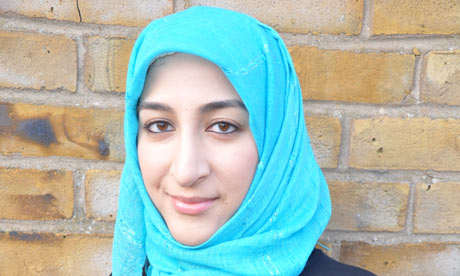
Remona Aly in her Muse T-shirt

Hijab-weariing rock fan Remona Aly.

God gave rock'n'roll to you! So US rock band Kiss chanted in the early 90s, a cover of the original song by British group Argent. My relationship with this "divine" gift started early. At 12, I riffled through my brother's vinyl collection and emerged a fan of U2, Faith No More and Led Zeppelin.

Full Article from The Guardian UK.