Friday, May 30, 2008

Struggles of Gay Muslims - Interview with Parvez Sharma

From the New York Blade

Local filmmaker Parvez Sharma discusses homosexual Muslims—and the trouble with U.S. activists who try to help them.

By TRENTON STRAUBE
Friday, May 09, 2008


Parvez Sharma's documentary, "A Jihad for Love," traverses 12 countries and nine languages as it follows the lives of disparate Muslims who try to reconcile their sexuality with their faith. Produced by "Trembling Before G-d"'s Sandi DuBowski and shot during five years, "Jihad" offers a rare glimpse into a complex and controversial world.

After debuting in 15 countries, the film plays in New York starting Wednesday, May 21. Sharma, a gay immigrant Muslim from India now living in New York, spoke with The Blade about misperceptions Americans have about the world's fastest growing religion (Islam is also the second most popular religion, after Christianity).


"Jihad" covers a variety of Muslims, from those living under extreme sharia law to those practicing the mystical Sufism. Is it a challenge for American audiences to put each person's story in its proper cultural context? Even the term "jihad" is usually interpreted in the U.S. as "holy war" though you're reclaiming it to mean "inner struggle."

My primary audience was a Muslim audience, otherwise I wouldn't have been able to make a film that was respectful of Islam. I knew that if I could get to Muslims, I could open doors to other audiences. That's what the film has been doing: Educating people tremendously about the complexities of Islam.

I try to present Islam with a little bit of sanity and with a perspective only an insider Muslim can have. I tried hard not to attack Islam. If I did, it would have been an angrier film and would not have won any credibility with any Muslims.

This is not a traditional coming-out film. We're all coming out as Muslims. The primary identity of all these people—including the filmmaker—is religion.

That begs the question, Why stay in a religion that condemns you?

Answering that was my primary impetus to make the film. So many of us as queer people have abandoned religion completely. Islam calls upon you to be part of a family and culture outside of the mosque. So abandoning religion is a difficult choice—you're abandoning religion, family, culture, a lot of things that go with being a Muslim.

In your film, a gay South African Muslim challenges the anti-gay interpretations of scripture, saying, as many liberal Christians do today, that Sodom and Gomorrah isn't about homosexuality, but about rape or hospitality. Are more Muslims open to newer interpretation of the Koran?

Scholars of all descriptions are engaged in looking at the Koran in light of the 21st century. Islam maybe has more ground to cover in a modern context [compared to Christianity and Judaism]. But a lot of it is happening.

The last battle that remains to be won—around marriage—is true of all religions. In my lifetime, I don't see the Christian church or Vatican or Islam saying homosexuality is okay. What I think is going to happen is people will look at the religious text, for example of Sodom and Gomorrah, and come up with readings that are different.

You've shown the film around the world, recently in Canada, Australia and Turkey. Have reactions varied?

Toronto reacted from point a view of knowing a little more about Islam than Americans. In Sidney, as they were celebrating the hedonistic celebration that is Mardi Gras, people became aware of how hard it is to be gay in other places. And then in Turkey, which is 99 percent Muslim but also secular, young people said the film should be more critical.

Critical of Islam?

In Turkey, extremist Islam is making a comeback and a lot of people living in big cities like Istanbul feel threatened. They'd rather be part of the European Union than be an Islamic country that implements the headscarf. [Their criticism of the film] comes from that place that's fearful about Islam.

A lot of people make the case that the spread of Islam is bad for gay rights and human rights in general.

I don't agree with that at all. Islam is exactly the same for gay rights as Christianity or Judaism. There are only six Islamic states that implement sharia (Islamic) law, and this is where it starts becoming a problem. It is when the state starts interfering in personal sexual life. But again, I want to stress that a majority of Muslims are living outside sharia law.

Paradoxically, under even the extremist regimes, same-sex sexual encounters are not uncommon, correct?

Definitely. There's greater level of fluidity. You're not talked about if you're holding hands with another man. Or a woman with a woman. Certainly the avenues for having same-sex contact in a purely sexual context are much more easily available because many times the sexes are segregated. Sexuality is fluid and very open in most Islamic societies. The act is not associated with guilt. In Christianity, there is a lot of guilt around sex and reproduction. But if you're taking on a political identity like having a gay bar or gay pride or gay marriage, you start having a problem.

I take issue with a lot of Western activists, the ones who are bashing Iran for example, who have the arrogance to assume their models of gay liberation can be applied to this context. I know for a fact that they cannot.

Two lesbians in your documentary mention online dating. Is the Internet a popular and safe mode of gay liberation and communication?

Absolutely. Iran has the worlds' richest blogosphere. But what's also happening is that a lot of content is monitored in Saudi Arabia, Egypt and Iran. A lot of activism is happening through the Internet, which has huge advantages and disadvantages. In Egypt, the government used the Internet to entrap (and imprison) gay men. So the Internet can be freeing, but [the users] have to use judgment with whom they talk to and how they talk.

Let's talk about asylum-seekers. "Jihad" follows an Egyptian who fled to France and Iranians who head for Canada via Turkey.

People have felt the film portrays the West in more positive light, like the West means freedom automatically. I don't agree with them. You see in the film how much the Egyptian has had to struggle. It's an uncertain freedom if you seek asylum in the West post-Sept. 11 where being a Muslim refugee of any color is a problem and having a Muslim name is a problem.

Is claiming homosexual persecution a viable reason to seek asylum?

Increasingly, it has been viable because there has been a wave of gay immigration cases. I'm afraid to say not all of them are genuine.

The question is: When people from Iran start seeking asylum in a Western country, does that give the opportunity in this climate to take that agenda of Iran bashing even further? I feel that a lot of this agenda picked up by gay activists in the West is Islamophobic and Iranphobic as well. I'm not the only person saying that. Even the Human Rights Watch has exercised a lot of judgment in how these individual cases are perceived in the press.

How would you rate Western gay press' coverage of LGBT issues in countries like Iran?

The U.S. gay press for the most part has been fairly immature. It's not entirely the fault of the gay press in U.S. It's part of a climate of ignorance. The sensationalism of cases out of Iran has been problematic. We are in political and social climate in which it is fashionable to attack Islam or to attack regimes that are seen as problematic regimes. When we attack these regimes, we make it more difficult for people living within those regimes. For example, when you accuse [Iranian President Mahmoud] Ahmadinejad of carrying out a systematic campaign against homosexuals you make that issue visible and force them to react a certain in which they weren't doing in the past.

There needs to be a greater responsibility exercised in criticizing regimes like Iran of carrying out pogroms against homosexuals. That is not the case. Ahmadinejad has bigger fish to fry.

Ahmadinejad was publicly ridiculed in the press for his infamous statement last fall at Columbia University.

I thought that was irresponsible reporting around the semantics of his comments, which was sensationalized profoundly. What he said was, "We don't have gays like you have in the West." The statement that was reported was "We don't have gays in Iran." He's quite right because of the different context of being. How do you explain these complexities? It's going to take a huge effort of responsibility not just of the press, but of filmmakers, activists, everyone, to do that.

Are Americans receptive to learning these complexities?

I think so. I've lived in the states for eight years. I'm as proud to live here as much as I've been alarmed. But Americans are definitely responsive to learning. The release of the film will engage them. I've seen that in so many countries. I see no reason for that to not happen in a city as rich as ours.

Bookmark and Share

Thursday, May 29, 2008

Kazakhstan Debates Polygamy Amid Regional Rise in Popularity

From Radio Free Europe

Wednesday, May 28, 2008

Central Asia: Kazakhstan Debates Polygamy Amid Regional Rise In Popularity
By Gulnoza Saidazimova

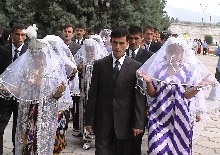
Tajikistan - Tajik Wedding, 2005
In Tajikistan, men can only have one wife by law, but the idea of legalizing polygamy was raised following the country's 1992-97 civil war (file photo)
(RFE/RL)
Want a second wife? Then simply get your first wife's consent and prove you can financially support another family. A new draft law in Kazakhstan would allow any man who is able to meet those two requirements to take a second, third, or even a fourth wife.

Proponents of legalizing polygamy say the new bill will help improve the demographic situation in the country. They cite Islamic customs, which allow Muslim men to marry up to four wives. And they say the new bill would give more rights to the wives and children of polygamous husbands.

Tangribergan Berdyungarov, a Kazakh parliamentarian, says the legislature is likely to hold a session soon to consider the issue. "The proposed bill is named 'On Marriage and Family.' There have been unofficial talks to legalize polygamy in Kazakhstan," he says. "I believe every deputy has his or her own opinion on the matter, and it will be reflected in the voting."

If Polygamy, Then Polyandry

Berdyungarov tells RFE/RL that he opposes the new bill. He has many supporters in parliament -- mostly women like deputy Bahyt Syzdykova, who calls the issue "nonsense."

Speaking at a televised roundtable in Astana on May 7, Syzdykova said she would propose legalizing polyandry -- allowing women to marry more than one man -- if parliament legalizes polygamy. "After all, men and women in our country have equal rights according to our constitution," she said. Syzdykova added that there is more need for a law giving greater rights to children born out of wedlock than any legalization of polygamy.

A woman from the city of Almaty voices a similar opinion. "Many women have become the second or third wives, but neither they nor their children have rights," she says. "I don't want to see the word 'polygamy' [in the new law], but I would like to see that men have obligations and are held responsible for all their relationships and the children born outside [official] marriages."

Polygamy has been practiced in Central Asian Muslim societies for centuries. Even during the Soviet era, some men took more than one wife, although only the first marriage was considered legal.

Kazakhstan decriminalized polygamy in 1998, but it remains a crime in the four other Central Asian countries. A man can face up to two years in prison for having more than one wife, but the practice is rarely prosecuted.

'Bring Happiness'

The Kazakh parliament has held debates on legalizing it several times in the last decade. The first initiative came from the League of Muslim Women of Kazakhstan. Amina Abdukarim Qyzy, the organization's leader, has said that polygamy would increase the country's population and "bring happiness to many men and women."

A 2004 poll by the "Express K" daily suggested that some 40 percent of Kazakh men supported legalizing polygamy. In the same poll, more than 73 percent of women said they wanted to be the only wife of their husband. Only 22 percent of women said they would not oppose living in a polygamous marriage, but only if wives lived in separate apartments and were equally and adequately provided for by a husband.

Murat Kulimbet, deputy editor in chief of "Kazakhstan Eylderi" magazine, supports legalizing polygamy. He says up to 30 percent of men in the country's south, where Islamic traditions have always been stronger, have more than one wife.

Polygamy has become more popular in Central Asia as people have returned to Islamic traditions following the collapse of the Soviet Union.

Through "nikah," or Islamic marriage, a Muslim man can take up to four wives with the consent of his current wives and if he is financially able to provide equally and fairly for new wives and children. Nikah, however, has no legal force in the region's secular states. Therefore, in the case of divorce or the death of a husband, the second and third wives of the man and their children have no rights.

In recent years, Muslim-dominated societies from Azerbaijan to Russia's Bashkortostan to Central Asia have seen attempts to legalize polygamy, but parliaments have always rejected them.

Benefits Of Legalization

In Kazakhstan and Russia, polygamy proponents say it would help raise sagging birthrates and stave off demographic crisis. In other countries, such as Kyrgyzstan and Uzbekistan, where thousands of men go abroad in search of work amid high unemployment at home, some people say the wives and children of those men who do not return would benefit from the legalization of polygamy.

In Tajikistan, the idea was raised after the bloody 1992-97 civil war, when the number of men decreased significantly. A group of Tajik women -- mostly the wives of polygamous husbands -- wrote a letter to the country's parliament, asking for their status to be legitimized.

Most observers see a direct correlation between polygamy and economic welfare. Many women agree to become the second or third wives of relatively wealthy men, as they are not financially able to provide for themselves. There is also reportedly an increasing number of cases where men take young girls as their second or third wife from parents who can barely make ends meet. The parents often give their daughters away for a financial reward.

"There may be a need for [polygamy] only among the rich in Uzbekistan," says an Uzbek man working in Kazakhstan. "Nowadays, most families can hardly make ends meet, and millions of Uzbeks work in Russia and Kazakhstan. I don't think [legalizing polygamy] is an urgent issue in Uzbekistan. Well, not from men's point of view."

Egypt: Court Upholds HIV Sentences, Reinforces Intolerance

From Human Rights Watch

For Immediate Release

Egypt: Court Upholds HIV Sentences, Reinforces Intolerance

Five Convictions in Fear-Driven Crackdown a Blow to Health and Justice

(Cairo, May 29, 2008) – A Cairo appeals court's decision to uphold the sentences imposed on five men jailed in a crackdown on people living with HIV/AIDS underscores the Egyptian government's dangerous indifference to public health and justice, Human Rights Watch said today. The May 28 ruling upheld the maximum three-year prison terms for each of the five, following a months-long campaign targeting men with HIV/AIDS. A total of nine men have been sentenced to prison so far.

"To send these men to prison because of their HIV status is inhuman and unjust," said Joe Amon, director of the HIV/AIDS program at Human Rights Watch. "Police, prosecutors, and doctors have already abused them and violated their most basic rights, and now fear has trumped justice in a court of law."

On May 7, a court of first instance in Cairo had convicted the five men on charges of  "habitual practice of debauchery," a phrase that in Egyptian law encompasses consensual sexual acts between men.

Before their first trial, a prosecutor told the men's lawyer that they should not be allowed to "roam the streets freely" because the government considered them "a danger to public health."

Since October 2007, Cairo police have arrested a dozen men on suspicion of being HIV-positive. The crackdown began when one man, stopped on the street during an altercation, told officers he was HIV-positive. Police arrested him and the man with him, beat and abused them, and interrogated them to name sexual contacts. Police then began picking up others based on information from those interrogations.

On January 14, 2008, a Cairo court sentenced four of those men to one-year prison terms on "debauchery" charges. An appeals court upheld those sentences on February 2. The present five defendants were referred for trial separately in March. Authorities released three other men, who tested negative for HIV, without charge, after months in detention.

While the 12 were in detention, doctors from the Ministry of Health forcibly subjected all of them to HIV tests without their consent. Doctors from Egypt's Forensic Medical Authority performed abusive anal examinations on the men to "prove" they had had sex with other men. Human Rights Watch has documented that such examinations conducted in detention constitute torture (http://hrw.org/reports/2004/egypt0304/). Police and guards beat several of the men in detention. A prosecutor told one of the men that he had tested positive for HIV by saying, "People like you should be burnt alive. You do not deserve to live." 

The prisoners who tested HIV-positive were chained to their beds in hospitals for months. After a local and international outcry, the Ministry of Health ordered the men unchained on February 25.

"Putting these men in prison serves neither justice nor public health," Amon said. "The Egyptian government and the country's medical profession must act to end this campaign of intolerance."

-----------------------------------------------------------------------------------------------------------------------------------------------------------------------------------------------

For more of Human Rights Watch's work on Egypt, please visit:
http://www.hrw.org/doc?t=mideast&c=egypt

For more of Human Rights Watch's work on Lesbian, Gay, Bisexual, and Transgender Rights, please visit:
http://www.hrw.org/doc/?t=lgbt

For more of Human Rights Watch's work on HIV/AIDS and human rights, please visit:
http://www.hrw.org/doc/?t=hivaids&document_limit=0,5


For more information, please contact:

In Berlin, Scott Long (English): +1-646-641-5655 (mobile)

In New York, Joe Amon (English): +1-212-216-1286; or +1-609-475-2365 (mobile)

In Washington, DC, Joe Stork (English): +1-202-612-4327; or +1-202-299-4925 (mobile)

In Washington, DC, Abderrahim Sabir (Arabic, French, English): +1-202-612-4342; or +1-202-701-7654 (mobile)

Wednesday, May 28, 2008

Muslims Try to Balance Traditions, U.S. Culture on Path to Marriage

From the Washington Post

By Michelle Boorstein

Washington Post Staff Writer
Tuesday, May 27, 2008; B05

As imam of one of the Washington region's largest mosques, Mohamed Magid counsels married couples, including those with a problem he sees among Muslim Americans: husbands and wives who were virtual strangers before they wedded.

Islamic practice bans unsupervised dating, and in transient 2008 America, traditional Muslims may wind up far from families who once oversaw the connection of two single people. Many African American Muslims are converts and do not have Muslim relatives who can help with the process.

A few years ago, Magid, imam of the All Dulles Area Muslim Society in Sterling, started something new: required premarital counseling for people who marry at the mosque. His wife recently launched a singles program meant to honor modesty and cut to the chase: participants meet in groups to discuss scriptural problems, read stories, and make lists of what they think are the most important characteristics for a Muslim wife or husband in the United States.

Although premarital counseling and singles programs are common for some faith groups, they are new in U.S. mosques, placing Magid and his wife on the vanguard of a drive to update Muslim practices and institutions surrounding marriage. The movement stems from concern among many Muslim American leaders that families are not keeping up with cultural changes, leading people to divorce and marry multiple times, or become alienated either from Islam or from mainstream American life.

Key issues include what Islam says about interfaith marriage, how well Muslims can know each another before they marry, and what the modern version is of a "wali," or guardian, a figure in Islam who is supposed to help women pick the right husbands.

"Generation gaps, cultural differences when people from the United States marry someone from overseas, interfaith marriage -- the issue of marriage is one of the most important in Islam here right now," Magid said. "Anytime there is a program at the mosque about these things, it's completely packed."

A commonly discussed problem is the surplus of single Muslim women. This stems partly from Islamic practice's broader acceptance of men marrying outside the faith than women.

Daisy Khan, a New York activist who counsels couples with her husband, an imam, organized a Valentine's Day event for singles -- 15 men and 63 women attended. Although she used to feel torn about interfaith marriage, she is now concerned that women will either be left unmarried or leave their faith. She tries to connect Muslim couples but also thinks pious Muslim women should be able to marry non-Muslims who also are pious.

"It's my obligation to shift a little, to give a little because it's important for them to stay within the faith," she said. "You have to clear up the mandate of: What is God's mission? I see God's hand in this."

In a Pew Research Center poll of Muslim Americans released last year, 54 percent of women said interfaith marriage is acceptable, compared with 70 percent of men.

Marriage practices are a growing issue among Muslims in part because melding into the mainstream is increasingly their goal, experts said. This is true for many first- and second-generation Muslims and U.S.-born converts. It is a complex balance, however, testing relations between parents and children and within new couples.

Many Muslim dating and marriage traditions exist to promote sexual reserve, particularly among women, but in 2008, separation between potential mates has lost its cultural moorings.

"It creates these experiences of weirdness where you're more comfortable with [non-Muslim] John at work than Mohamed" at the mosque, said Zarinah El Amin-Naeem, 28, an anthropologist.

The Muslim Alliance in North America, a national group made up largely of prominent black Muslims, held its first national conference in the fall and named marriage reform as one of its top priorities. A concern is the rush into marriage, either to have sex or because structures that once screened potential spouses, such as close-knit, large families and cultural isolation, have diminished.

"In Islamic culture there is no dating and no kind of middle ground, so the sense is, if this person is a good person, let's get married. The impulse isn't to prolong a courting relationship. Our advocacy is it needs to be prolonged somewhat," said Ihsan Bagby, co-founder of the Muslim Alliance in North America.

Issues related to marriage play out differently across the Muslim American community. The problem of strangers marrying is more common among African American Muslims than among immigrant families because many are converts and might not have families involved in their faith lives, experts said. Tensions surrounding interfaith marriages are more common among Muslims from South Asia, who tend to be more traditional, than those from Africa or Turkey.

And, of course, many Muslims are secular or are liberal about their faith, perhaps using a Muslim dating Web site such as naseeb.com but not agonizing over premarital sex or seeking a wali. Even for non-observant Muslims, however, "when it comes to the issue of marriage, because Muslim families tend to be so involved, there is more tradition involved than in other aspects of their lives," said Dalia Mogahed, executive director of the Gallup Center for Muslim Studies.

Interfaith marriage is a huge topic with wide cultural ramifications. Because Islamic tradition, not law, holds that a Muslim man can intermarry but not a woman, a substantial gender gap in the dating pool has opened as children and grandchildren of immigrants have grown up.

The Koran says for Muslims to marry "believers," the meaning of which has long been the source of great debate but has been widely interpreted to include Christians and Jews. Although the Koran does not address the gender issue directly, tradition has held that women are more easily subjugated, and therefore a Muslim woman in an interfaith marriage could be forced by a Christian or Jew to live and raise her children outside of Islam, while a Muslim man in an interfaith relationship would be able to control the household's faith.

Abdullahi Ahmed An-Na'im, an Islamic family law expert at Emory University, argues that gender dynamics have changed in a way that makes interfaith marriage more reasonable under Islamic tradition. "In social reality today, men are not dominant in the marriage relationship. The rationale of historic rule is no longer valid," he said. "But people are not willing to accept this. This is a major source of tensions."

Qur'an Shakir, who runs national Muslim dating events and writes a column on Muslim dating, said a lot of people debate the value of a dowry today, even as a symbolic commitment, while others think that the position of wali should be updated to be more like a relationship mentor and less like a guardian, and that men should have walis, too.

"People need to be open to different interpretations of the Koran," she said.